in 1959, Laurie Records has launched a new subsidiary label, Andie
Records. It will release the same kind of records that Laurie has issued
in the pop and jazz fields. But the new label will be serviced by other
distributors, according to a.&r. chief Gene Schwartz. First
recordings are by the Chippendales, whose disking is "What a Night," and
the other is by the Quentins. The group recorded in 1959 the single
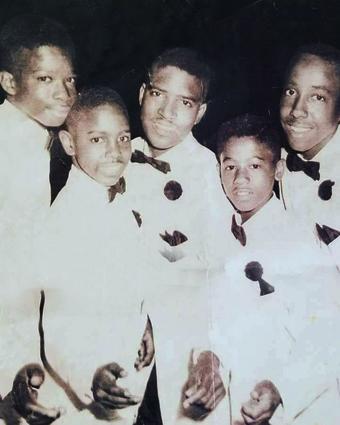
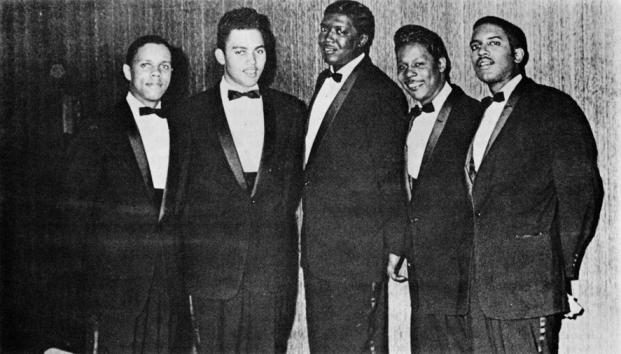
"You'll Never Know" b/w "Mi Amore". The Quentins come from Westchester
County, N.Y. and consisted of Don Nicita (Lead), Richard Elter, Chuck
Smith and Gary Stem .
Neil
Stevens & The Dee-Vines
(1)
However before being called the "Quentins" the group had
already recorded a first record where they accompanied the singer Neil
Stevens in October 1958 on "More And More" and "What Could Be Better".
The single will be released by Brunswick Records as Neil Stevens &
The Dee-Vines. In 1960, Neil Stevens joined the Temptations
as Lead singer with Larry Curtis, Artie Sands, and Artie Marin, not to
be confused with the famous Motown group by the same name. This
lesser-known group from New York released one Top 40 hit, "Barbara," in
1960, about one year before the more famous Temptations were founded.
Neil Stevens went solo shortly after the release of "Barbara."
In October,1960 Don Nicita & his fellows recorded "I Believe" and
"Worlds Greatest Lover" released by the Rocco Catalano's Lano label
from Port Chester,N.Y.. This time they take back their original name The
Dee-Vines . The group appeared on Ted Mack's Original Amateur Hour on
May 23, 1960 and perform "Lonesome Road" .
1961 - Wishin' Well / New Rockin' Baby (La Salle 501)
Unreleased :
1961 - I'll Do What You Want Me to Do (La Salle)
The Chanteurs (1)
1963 - You've Got A Great Love / The Grizzly Bear (Vee Jay 519)
Biography :
Eugene Booker Record was born in Chicago on the 23 December 1940. As a
young boy his interest in music first took hold with song writing and
guitar lessons. When he was thirteen at Englewood high school he
participated in musical programs and had visions of getting into the
music business. At high school he became a member of the vocal group the
Wrens. He next formed the Chanteurs in the late fifties with future
Chi-Lites Robert Lester and Clarence Johnson and Sollie McElroy from The
Moroccos.
The Wrens with Eugene Record (Middle)
In 1954, After the first two years of the Flamingos, Lead singer
Sollie McElroy sang with the Moroccos for about three years. After
scoring several regional hits, The Moroccos disbanded in 1957. In 1961,
Sollie McElroy joined The Chaunteurs which included Clarence Johnson
(Baritone), Robert "Squirrel" Lester (Second Tenor), Eddie Reed (Bass)
and Eugene Record (First Tenor). Sollie McElroy and Eugene Record shared
Lead on the La Salle Label release, which sounds more like a 1957
recording. Burt Bowen (Baritone) replaced Sollie and in 1963 the group
cut "You've Got A Great Love" b/w "The Grizzly Bear" on Vee Jay records
in 1963 as The Chanteurs.
The Chaunteurs (1961) : Clarence Johnson, Robert Lester, Eddie Reed, Sollie McElroy and Eugene Record
The Next Year, Eugene Record, Robert "Squirrel" Lester, and Clarence
Johnson) teamed up with Marshall Thompson and Creadel "Red" Jones of the Desidero's
to form the Hi-lites. Noting that the name Hi-lites was already in use,
and wishing to add a tribute to their home town of Chicago, they
changed their name to "Marshall and the Chi-Lites" in 1964. Johnson left
later that year, and their name was subsequently shortened to The
Chi-Lites.
The No Names were a South Jersey-based doo-wop group that signed with
Guyden Records in July, 1964, to put out “Love,” a composition of two
of its members, Al Morrison and Doug Gordon. The other members of the No
Names were Ed Sattile, Emiry Rowand and Bob Danzie. They got their name
when they took the record they recorded themselves at the Baker studio
above the notorious Oasis Motel in Camden, New Jersey, to Jerry Blavat
to play on his program on WCAM, the city-owned station in Camden, New
Jersey. The studio was in the City Hall. Jerry liked the record, played
it, and when he asked the group their name, they admitted they had no
name. Hence, "The No Names."
Jerry Williams, Morris Spearmon, Roscoe Brown and Ernest Lemon
The Swinging Hearts (Chicago)
Personnel :
Morris Spearmon (Lead)
Ernest Lemon
Jerry Williams
Lee Brown
Roscoe Brown (Bass)
Discography :
1961 - Please Say It Isn't So / Something Made Me Stop (Stop Shopping Around) (Lucky Four 1011 / Diamond 162)
1963 - How Can I Love You / Spanish Love (620 1002 / NRM 1002)
1963 - Something Made Me Stop (Stop Shopping Around) / Pony Rock (620 1005)
1964 - You Speak Of Love / I've Got It (Magic touch 2001/620 1009)
Biography :
The Swinging Hearts were a five-man group from Robbins, in the south
Chicago suburbs, featuring the excellent lead of Morris Spearmon and the
outstanding bass of Roscoe Brown. Other members were Ernest Lemon,
Jerry Williams, and Lee Brown (A cousin or Brother of Roscoe). The four,
minus Lee Brown, had attended Blue Island High and had sung in the
Passions, a group with female lead Addie Bradley. Record entrepreneur
Don Talty discovered the group but wanted only Bradley.
Jan
Bradley & Don Talty
He rechristened her Jan Bradley and she went on to fame with "Mama
Didn't Lie." The remaining Passions added Lee Brown and refocused their
career with Spearmon as lead under the name Swinging Hearts. Their first
release, "Please Say It Isn't So, was first released later that year.
The master was purchased in 1965 and was released again that year on
Diamond Records for national distribution.
The Passions. (Lef to right) Ernest Lemon, Morris Spearmon, Jan Bradley , Jerry Williams and Roscoe Brown
The Swinging Hearts recorded doowops in a more traditional vein with
their next release from 1963, on Six-Twenty, the Spearmon-composed
"Spanish Love," a Latin-style song with a perky beat, backed with a
droopy ballad, "How Can I Love You". The group's last release with the
company was "You Speak of Love" backed with "I've Got It" . It is felt
that if the members of this group had been single and free of other
responsibilities and obligations, they might have become quite popular.
As it was, family responsibilities kept them from traveling to promote
their excellent discs.
Songs :
Please Say It Isn't So Something Made Me...... How Can I Love You
Clarence "Pop" Gray , Charlie "Stoney" Dimbo, Emmanuel "Doc" Robinson, Frank McRae & George "Bronx" Rivers
The Master-Tones (White Plains, New York)
Personnel :
Clarence "Pop" Gray (Tenor Lead & Guitar)
George "Bronx" Rivers (First Tenor)
Emmanuel "Doc" Robinson (Second Tenor)
Frank McRae (Baritone)
Charlie "Stoney" Dimbo (Bass)
Discography :
1954 - Tell Me / What'll You Do (Bruce 111)
Songs :
The Master-Tones formed around 1951 while attending Battle Hill
Junior High School in White Plains, New York. They were neighborhood
pals who lived on Russell and Fulton Streets.The group lineup consisted
of Clarence "Pop" Gray (lead), Charlie "Stoney" Dimbo (bass), Emmanuel
"Doc" Robinson (2nd tenor), Frank McCray (baritone) and George "Bronx"
Rivers (1st tenor). " They first started singing at school. Once the
guys became serious about their singing, they needed a name for the
group and chose The Hearts. Billy Barrels, became their manager and had
the guys rehearsing at his house in Greenburgh, New York, almost every
night.
Emmanuel
"Doc"
Robinson
By 1954, they were performing at local clubs. One of those clubs was
the Red Rose located in New Rochelle, New York on North Avenue. Like
dozens of other young vocal groups at the time, they knew that their
path to fame and fortune started at the legendary Apollo Theatre. Record
company executives and scouts looking for new talent attended the
weekly amateur night shows and were ready to offer contracts on the spot
to promising groups. Another friend of the group helped them secure
them a contract at Bruce Records in New York City.The Hearts auditioned
with four original songs but only two were to be recorded. However, a
quick name change was in order due to the fact that there already was a
"Hearts " group in existence. The guys talked it over and because they
were making a Master Record … they became the Master-Tones .