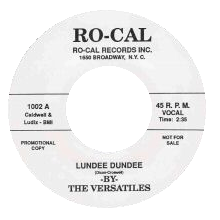
1960 - Lundee Dundee / I'll Whisper In Your Ear (The Versatiles) (Rocal 1002)
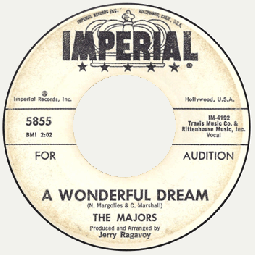
1962 - A Wonderful Dream / Time Will Tell (Imperial 5855)
1962 - She's A Troublemaker / A Little Bit Now (Imperial 5879)
1963 - Anything You Can Do / What In The World (Imperial 5914)
1963 - Tra La La / What Have You Been Doin' (Imperial 5936)
1963 - Get Up Now / One Happy Ending (Imperial 5968)
1963 - Life Begins / Which Way Did She Go (Imperial 5991)
1963 - Ooh Wee Baby / I'll Be There (Imperial 66009)
Lps :
1963 - Meet The Majors (Imperial Lp 9222)
A
Wonderful Dream / Ooh Wee Baby / Time Will Tell / Tra La La / Twist and
Shout / A Little Bit Now / She's a Troublemaker / Don't Lose your Cool
/ I Wonder Who's Dancing With Her Now / What in the World / Come on
Come On / Anything You Can Do
The Versatiles (2)
1960 - Lundee Dundee (The Majors) / I'll Whisper in your ear (Rocal 1002)
The Performers (3)
1966 - Just Dance / Love Is A Answer (ABC 10777)
Biography :
Robert
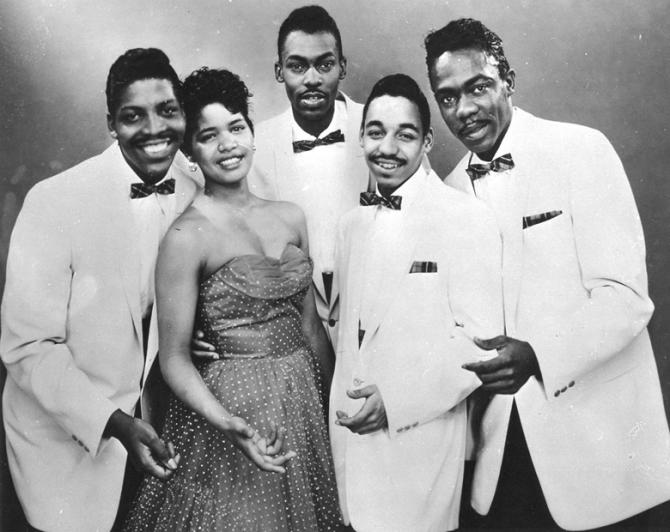
Morris, Gene Glass, Frank Troutt, Rick Cordo, and Ron Gathers made up
the original quintet, with Idella Morris soon replacing her brother
Robert. The group first called themselves The Premiers and formed in
Philadelphia in 1959. Although they attended different high schools,
they hung around together after school, and on weekends, in Harlan
Street, performing on the street corners between 19th and 20th streets.
Idella was the youngest member at nineteen years and Gene Glass, who had
just returned from the US Air Force, was the oldest group member, being
twenty five.
The group met club owner Buddy Caldwell early in 1960 and he
persuaded them to record for his Ro-Cal label. They recorded "Lundee
Dundee" and "Let Me Whisper in Your Ear" as The Versatiles since the
studio apparently had another group listed on their books as The
Premiers. The record had local success, but Ro-Cal just wasn’t geared up
for national distribution and the group received little in the way of
royalties. At that point some of the male members went off to the
service. Two and a half years later, the group reformed, with an
identical lineup, as The Majors.
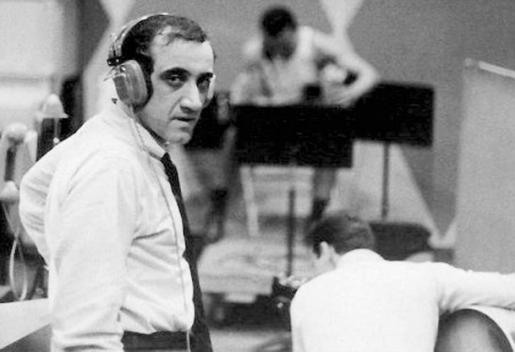
Jerry Ragovoy
When the group reformed Jerry Ragavoy heard them perform and he
already knew of "Lundee Dundee". Ragavoy liked The Majors enough to get
them a recording deal with Imperial. In July 1962 they turned up at the
Imperial studios and “A Wonderful Dream” b/w “Time Will Tell”. “A
Wonderful Dream” entered the Cashbox pop chart on the 4th of August and
rose to # 20 on September the 22nd, it made # 22 on Billboard and # 23
on the national R&B chart.
Following the success of “A Wonderful Dream” a lone and now quite
collectible, LP was issued and, in rapid succession, six more singles.
The next release was a bouncy tune in the mould of Wonderful Dream, “A
Little Bit Now (A Little Bit Later)” b/w “She's A Troublemaker”. Both
sides made moderate moves on the national listing. “A Little Bit Now”
peaked at # 63 and “She’s A Troublemaker” reached # 83. Three of the
groups remaining five Imperial releases made the Bubbling Under list on
Billboard.
“Anything You Can Do” reached # 117 in Februrary 1963. “Your Life
Begins at Sweet Sixteen” made #125 in September 1963 and “I’ll Be There”
reached #113 in February, 1964. At this point The Majors contract with
Imperial Records concluded. The Majors, with their line-up intact,
recorded just once more. In 1966 they entered Frank Virtue's studios as
The Performers. ABC-Paramount issued the Peter DeAngelos’ produced
disc, but it failed. The group continued to tour during the 1960s, but
made no more recordings and disbanded.
In a 1986 a Dick Clark TV special gathered all of the original
members for a performance. Rick Cordo, Idella Morris, who had by this
time changed her name to Haleema Alkhatib and Gene Glass then,
recommenced working as The Majors. Sometimes Troutt and Gathers also
join them.
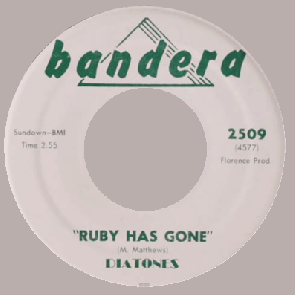
1961 - Oh Baby, Come Dance With Me / Ruby Has Gone (Bandera 2509)
Unreleased :
1961 - Oh Why Oh Why (Bandera)
Biography :
Bandera was a small Chicago label launched by Vi Muszynski, and her
son Bernie Harville, with money Muszynski made off one of her biggest
discoveries, the Impressions. The label released a variety of music in
the late '50s and early '60s, from hillbilly and rock, to blues and
gospel.
The Diatones were a faily young group. They cut three magnificent doo
wop tracks, "Oh Baby, Come Dance With Me", "Ruby Has Gone" and the
previously unreleased "Oh Why Oh Why". The Diatones were equally at home
with the heartfelt ballad as they were with the uptempo number. They
all possessed fine voices and produced polished performances.
Before
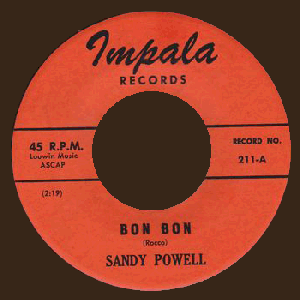
Lenny Rocco completed "Sugar Girl" and "Rochelle", he married his
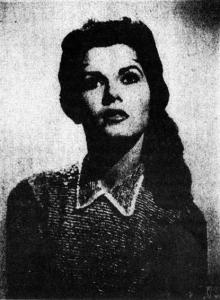
sweetheart, Sandy Pouls (aka Powell) . Sandy Powell was a fine singer
and recorded two song in 1958. The vocal undercoating was generated by
the Future Rocks. Freddy Faulkner, Barry Pouls (Sandy's brother), Ross
Matico and Bob Gardiner backing Sandy's two sides "Bon Bon" b/w "Pistol
Packin' Papa".
Sandy Powell
In late '58 or early 59', the same guys recorded with Lenny "Sugar
Girl" b/w "Rochelle ". The single was etched in 1961 on Delsey
(Billboard April 3. 1961). The Rocks were a constantly changing line-up
and broke up. Rocco and Freddy Faulkner debuted sometime later as a
duet. In 1963 Freddy Faulkner recorded as a solo artist for Swan Records
the sides "Cigarettes & Matches / Little Driftin' Amy." He
eventually surfaced with the Illusions . Barry Pouls ceded a somewhat promising peregrination with the original Premiers (Mink & Best).
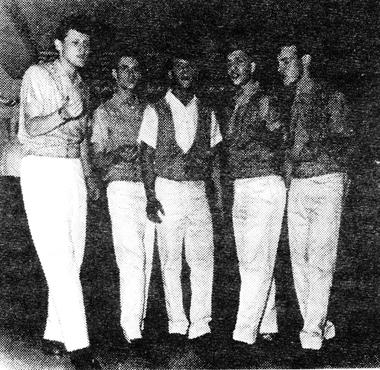
Barry Pouls, Bob Gardiner, Lenny Rocco, Ross Matico & Freddy Faulkner
In 1960, Lenny Rocco sings with the Jolly Gents, a vocal and
instrumental group, they toured two years all around the country . They
hobnobbed with the likes of lee andrew and the Hearts, len Barry, the
Platter, Isley Brothers, Bobby Darin, Danny & The Juniors and Johnny
Maestro & The Crest, and often backed these artist on instrumentals
or vocals. Sadly, they never set foot in Studio. Fran Williamson
ushered Lenny and the group (with some personnel change), dubbing
themselves Robin Hood & The Merri Men into RecoArt Studios where
they spliced two sides together "We Had A Quarrel" and "Maryann".
1957 - Who Knows Better Than I? / Mary, Hear Those Love Bells (Standord 100)
1957 - Who Knows Better Than I? / I'm So Blue (Eldorado 511)
Unreleased :
1957 - Tilly, Take Your Time (Standord)
Bill Baker & The Chestnuts (2)
1959 - Won't You Tell Me My Heart / Tell Me Little Darling (Elgin 007/008)
1959 - Wonderful Girl / Chit Chat (Elgin 013/014)
Marvin Baskerville & The Five Chestnuts
1958 - Chi-Chi / Chapel In The Moonlight (Drum 001/002)
The Five Chestnuts
Singles :
1959 - My kind Of Baby / Chi Chi (Elgin 002/003)
Unreleased :
1958 - I’m So Glad (Drum)
Marvin Baskerville / Hayes Baskerville & The Five Chestnuts
1958 - Chi-Chi / Billy (My Kind Of Baby) (Drum 003/004)
Hayes Baskerville / Norven Baskerville & The Five Chestnuts
1958 - Billy (My Kind Of Baby) / My One And Only Love (Drum 003/004)
Vicki Lee bb The Five Chestnuts
1959 - Crying My Heart Out / With All My Heart (Drum 017/018)
----------------------
The El-Lanos
1989 - I Wonder Why / In Mexico (Crescent 200)
Biography :
The
Chestnuts were named for their home state, Connecticut. They were from
New Haven and the original members of the group were Leroy Griffin
(lead, but not the lead singer of another New Haven group, The Nutmegs),
Lymon Hopkins (first tenor ), Frank Hopkins (second tenor), Jimmy
Curtis (baritone), and Reuben White (bass) . When they thought they were
ready for a shot at recording, they made the rounds of a number of
independent record companies in New York City without much success. The
group thought about their status and felt that if they featured a female
lead singer, they would have a more unique sound and have a better
chance for a recording contract.
At
this time they contacted someone whom they thought would be the perfect
addition to the group, and so Ruby Whitaker became the lead voice of
the group (When Ruby came in, Leroy went out). Now the Chestnuts were
set and they were put in contact with long time record producer and
company owner Joe Davis. He had previously went out on his own with the
Beacon label, and then Jay-Dee Records, and had good sellers with The
Mellows and Dean Barlow and The Crickets. The Chestnuts were set to
record on another label, this one called Davis Records. In June of 1956
Davis # 447 is released featuring The Chestnuts on "It's You I Love" and
"Love Is True". The 'A' side "Love Is True" gets good airplay in New
York and Philadelphia, especially from Herman Amis and Doctor Jive in
the Big Apple, and Jocko in Philadelphia. Although the song is an
excellent group ballad featuring Whitaker's lead, sales do not dent the
top hit charts and Joe Davis readies another try for the group.
In
September of the year, The Chestnuts record "Brother Ben" and "Forever I
Vow" on Davis # 452. Unfortunately, not enough record buyers followed
through on this great song and Davis dropped the group from the label.
In February of 1957, the group signed on with a Connecticut outfit
called National Enterprises which featured a record label called
Standord Records located in the group's home town of New Haven. Standord
would become famous as the original label for The Five Satins epic hit
"In The Still Of The Night".
Martin Kugell, the head of Standord Records, promotes the Chestnuts
recording of "Who Knows Better Than I" b/w "Mary Hear Those Love Bells".
By May Standord # 7701 featured "Who Knows Better Than I?" as by Ruby
Whitaker & The Chestnuts, and the new flip side was "Mary Hear Those
Love Bells" as by Lymon Hopkins & The Chestnuts. The song "Who
Knows Better Than I?" was also released on Eldorado Records on # 511
with "I m So Blue" on the flip side.
In early 1959, Ruby Whitaker had left the group, but the Chestnuts
carried on with a lineup of Lymon Hopkins, Frank Hopkins, a third
brother Arthur Hopkins, Reuben White, and new lead singer Bill Baker who
had spent some time in New Haven's Five Satins. A Connecticut record
producer named Clarence Drum began two local labels in 1958, Elgin and
Drum Records. He signed The Chestnuts to his label and in February of
the year Elgin # 007 is released featuring "Won't You Tell Me My Heart"
and the flip side is listed as by Bill Baker & The Chestnuts on the
song "Tell Me Little Darling".
Bill Baker (Top) & The Chestnuts (2)
During May of the year Elgin Records releases "Chit Chat" and a
version of The Five Satins song "Wonderful Girl" listed as by Bill Baker
& The Chestnuts on # 021. Neither of the Elgin releases did much
for the group or the label. Further sides for the labels by the group
with new members Marvin and Hayes Baskerville included "Chapel In The
Moonlight" by Marvin Baskerville & The Five Chestnuts, and "Billy My
Kind Of Baby" by Hayes Baskerville & The Five Chestnuts both on the
Drum label.
"I
Wonder Why" b/w " In Mexico" was an unreleased acetate who Stevie
Dunham purchased in New Haven, CT, in 1988. Probably recorded in
1956-57. It is speculated this group was the Five Chestnuts (Chestnuts)
from New Haven, CT. Stevie Dunham's partners at the time did not want to
use the Five Chestnuts on the issue of this 45 and left it up to steve
to put a name to an acetate that only listed song titles but no group
name. So he christened it The El-Lanos. The record was released on
Crescent, in July of 1989.
1957 - If I Could Make You Mine / Don't Go (Holiday 2607)
Biography :
The Ivories started in early 1955 with Johnny Hicks (lead tenor),
Dave Cole (first tenor), Joe Shallow (second tenor), Johnny Earl Jackson
(baritone), and James Coney (bass). The pianist and arranger was
Sylvester Bradford. The group took its name from Sylvester's piano keys:
the Ivories. They auditioned for George Bennett, owner of Jaguar
Records and cut "Alone " b/w "Baby Send A Letter". The record was
released in November 1955. By late 1956, Dave Cole was replaced by
second tenor Lucy Cedeno & Johnny Earl Jackson left. In early 1957,
the Ivories changed their name to the Love Notes.
Pretty
soon they had a contract to record for Danny Robinson and Clarence
Johnson's Holiday label. At their first session, they recorded "United"
and "Tonight,". "United" started taking off in New York. It did so well
so quickly, that the Love Notes were hurried into a show at the Apollo.
Somewhere along the way, the Love Notes managed to fit in a second
session. This time the songs were "If I Could Make You Mine" and "Don't
Go," another pair led by Johnny Hicks. They were released in mid-August,
1957. Shortly after the band broke up.
The Love Notes (3) - Lucy Cedeno, Joe Shallow, James Coney, Johnny Hicks
After leaving the Ivories, Johnny Earl Jackson formed a new Ivories
group consisted of Johnny Earl Jackson (baritone/bass), his girlfriend,
Ella Lewis (lead), her brother, Richard Lewis (first tenor), Moses
Brown (baritone), and a second tenor named "Blinky." They recorded a
pair of tunes "Me And You" b/w "I'm In Love" for Mercury. Then Moses
Brown got disgusted and left the Ivories, to be replaced by a baritone
named "Chink."they changing their name to the Ivoleers and recorded
"Lovers' Quarrel" and "Come With Me" for Bobby Smith's Buzz label in
early 1959.