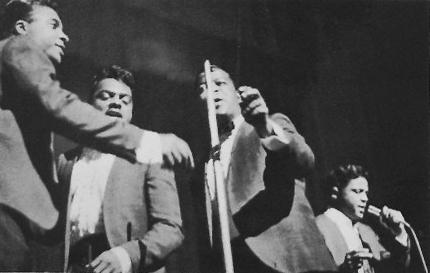
Willie Logan & The Plaids (3)

Willie Logan & The Plaids (3)

The Billy Dawn Quartet (Brooklyn, New-York)
aka The Four Dukes (1) aka The Heralds
Personnel :
Billy Dawn Smith (Lead)
Donnie Sehested (Tenor)
Tommy Smith (Baritone)
Edward "Sonny" Benton (Bass)
The Four Dukes (1)
The Heralds
The Four Kings (3) (Menphis, Tenesee)
aka The Canes
Personnel :
Don Bryant (Lead)
James "Jamie" Bryant (Tenor)
Elvin Lee Jones (Second Tenor)
Lionel Byrd (Baritone)
Discography :
Biography :
1942, Memphis, Tennessee, USA. A significant songwriter for Joe Cuoghi"s (and then Willie Mitchell"s) Hi Records, especially for (and sometimes with) his wife, Ann Peebles, Bryant was also a superb soul stylist, although most of his own recordings for Hi were cut long before Al Green, in particular, gave the label the commercial soul base it needed for continued survival. One of 10 children, Bryant"s father (Donald Snr.) featured in the gospel quartet the Four Stars Of Harmony, and in 1955, Don Jnr. and four of his brothers formed their own gospel group, the Five Bryant Brothers, which soon became "secularized" as the doo-wopping Quails.

At Booker T. Washington High School, Bryant joined a group variously called the Canes and the Four Canes, named after their "manager", local Radio WLOK DJ, D. Cane Cole. or their live gigs the Canes dressed in striped jackets and straw hats and carried walking canes. Don"s brother James was also in the group, along with Lee Jones and William Walker, reputed to be the later Goldwax, Checker and Pawn soulman, (Wee) Willie Walker. A group called the Canes were taken to Stax Records by D. Cane Cole in early 1962 where they cut "Why Should I Suffer With The Blues", but they have since been identified as probably being the Largoes, led by Lorece Thompson.


Personnel :
Samuel Jones
Alvin Standard
Kenneth Patterson
George Powell
Jimmy Ellis
Discography :
Biography :
Before its glory days as Stax, the label was called Satellite — founded in 1957, by Jim Stewart in his wife’s uncle’s garage in Memphis. Stewart was a fiddle player and so his tastes naturally leaned toward country music, which is what he originally sought to record and release on Satellite, along with rockabilly and pop tunes. A year after starting out, Stewart got a much-needed financial boost from his sister Estelle Axton, who mortgaged her house to buy a console tape recorder, and in so doing, became a financial partner in Satellite. In 1959, she helped the burgeoning label out of the garage and into a better facility in Brunswick, Tenn. (about 20 miles northeast of Memphis).


Songs :
The Veltones

The Ramblers
Carlis "Sonny" Monroe (Lead)
James "Ooh Wee" Gibson (First Tenor)
Johnny Alvin (Second Tenor/ Baritone)
The Ramblers (2)
Singles :
1963 - Oh Baby / Fine Fine Girl (Atlantic 2207)
1964 - Lonely Nights / Has It Happened To You Yet (Lu-Pine 124/Lu-Pine 1020)
1966 - (I'm A Fool) I Must Love You / Love, Love, Love (Big Wheel 321/322)
1966 - Standing On Guard / I Can't Help It (Big Wheel 1967)
1967 - Love Look In Her Eyes / In Time For The Blues ((Big Wheel 1971)
1967 - Good Good Feeling / Love You Like You Never Been Loved (Big Wheel 1972)
Biography :
The Falcons were during their history two groups with the first group having two eras. Coming together in the mid 50's, with a mixed race line-up of Bob Manardo, Eddie Floyd, Ton Shelter and Arnett Robinson, with Willie Schofield joining soon after. Eddie Floyds uncle Robert West became the groups manager. Bob Manardo was soon drafted and Tom Shelter decided to enlist himself. West held auditions which in turn lead to Joe Stubbs joining the ranks along with guitarist Lance Finnie, Mack Rice following not too long after replacing Arnett Robinson.
Without going into too much detail this was essentially the first era of the group, the second, after changes to the line up lead to Wilson Pickett joining the group to provide vocals. Not long after signing for Atlantic and after just one session and one solitary release 1962, the group split, most of the group did have solo careers by this time as well as their time with the group.

This left West with just a name, a name he had no intention of seeing become history. Early 1963 West saw a group play in Cleveland, The Fabulous Playboys, coincidentally one he managed.

The Ramblers (2)